Fireweed blooming above an Alaska lake and mountain landscape

Alaska-based · Telehealth throughout Alaska

After the fire, something can still bloom.

You do not need to have everything figured out before reaching out. We begin by understanding your experience, your relationships, and what may be keeping you stuck—creating space for greater understanding, regulation, and connection.

Botanical illustration of a fireweed spike

Fireweed is one of the first plants to return after wildfire—a living emblem of renewal.

Our name

Growth can begin again.

Fireweed does not wait for the ground to be perfect. It grows in disturbed and scorched soil, bringing life and color back to places that have been through fire. We chose the name Fireweed Mental Health because people can do that too.

What has happened to you is part of your story, but it does not have to determine what comes next. Biology, relationships, family, development, culture, environment, and accumulated experiences can all shape the way we respond to the world. Therapy can offer a place to make sense of those patterns and create room for something different.

Individuals Couples Families & caregivers Telehealth Relationship-centered

Understanding comes first

Every person has a story, and understanding that story matters. What you are experiencing today can be shaped by relationships, family, biology, environment, and the experiences that have accumulated throughout your life.

At Fireweed Mental Health, we believe meaningful change begins with understanding. We take the time to understand you—what you have experienced, what you are experiencing now, and what may be influencing the way you feel, respond, and connect with others.

Whether you are coming as an individual, a couple, or a family, understanding what is happening and why can create new possibilities for healing, connection, and growth.

Children & teens

Big feelings, withdrawal, conflict, school stress, or behavior that seems hard to understand can be signals that something underneath needs attention. Young people and caregivers can begin to understand what is happening and what their responses may be communicating.

Adults

Sometimes people feel overwhelmed, disconnected, on edge, stuck in old patterns, or simply unlike themselves. Therapy can create space to uncover what may be driving those experiences and make room for different responses.

Families & caregivers

What affects one person often affects the whole household. Families can notice recurring patterns, understand one another more clearly, and create conditions for greater safety and connection.


The science behind our approach

Why the nervous system matters

Thoughts and feelings do not happen separately from the body. Our nervous system is constantly taking in information from the world around us and shaping—often outside conscious awareness—whether we connect, protect ourselves, or pull back.

Understanding those responses can make behavior feel less mysterious and less like a personal failure. Polyvagal Theory is one of the frameworks that informs this work, alongside broader knowledge about development, relationships, trauma, and human biology.

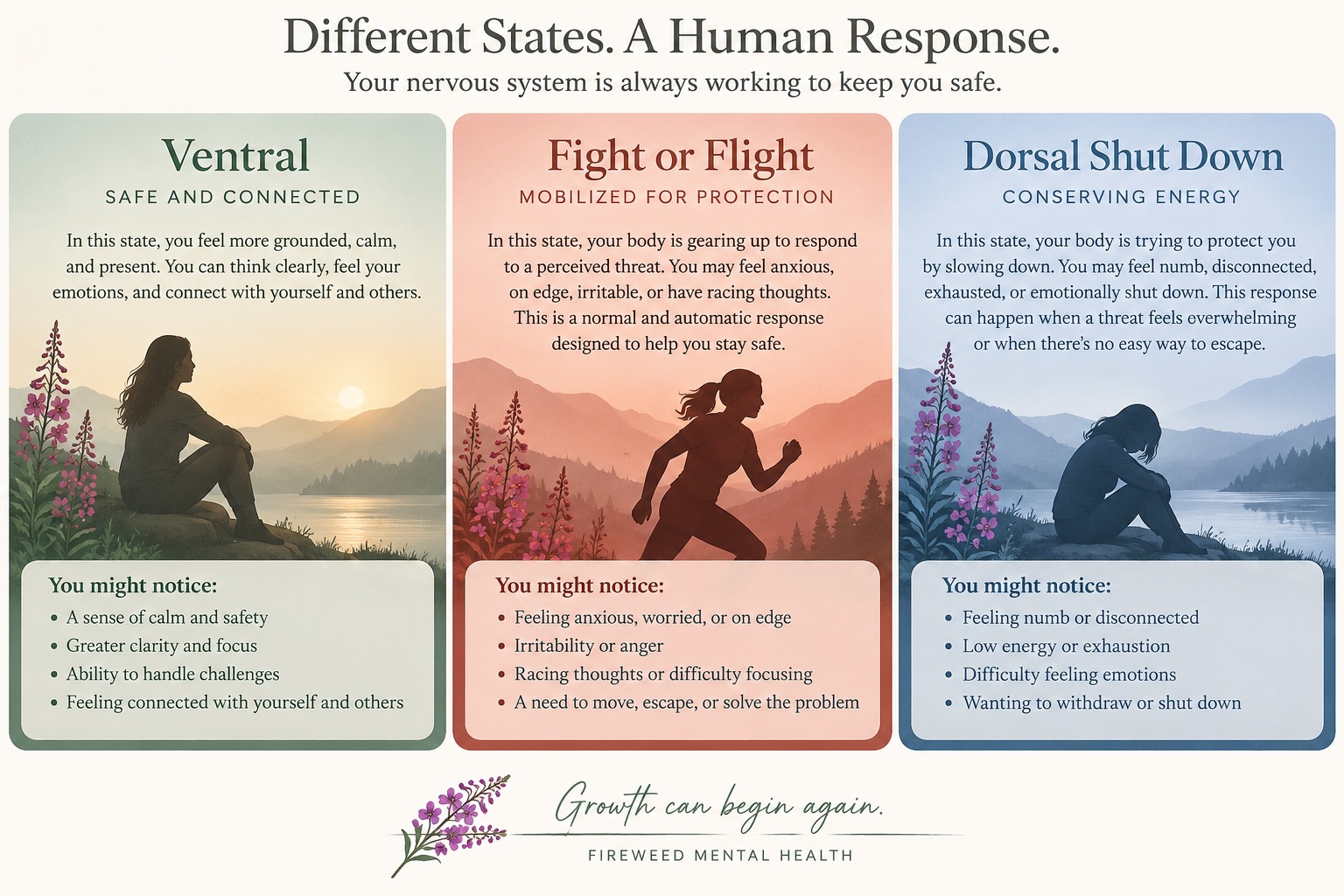
Illustrated guide to ventral, fight or flight, and dorsal shutdown nervous system states

Connected

Safe enough to engage

When we feel sufficiently safe, it is easier to think, learn, play, listen, rest, and repair relationships. We have more access to curiosity, flexibility, and connection.

  • Children can take in comfort and try again
  • Adults can think and feel at the same time
  • Families have more room for difference without rupture

Protective energy

Ready to fight or flee

When the body senses threat, energy rises. That can be lifesaving in real danger, but exhausting when the alarm stays on during ordinary life.

  • Children may become loud, restless, fearful, or defiant
  • Adults may feel irritable, anxious, urgent, or controlling
  • Families may find small problems escalating quickly

Conserving energy

Pulling back or shutting down

When fighting or escaping does not feel possible, the body may protect itself by reducing energy and connection. That can look like numbness, fog, withdrawal, or exhaustion.

  • Children may go quiet, hide, or seem not to care
  • Adults may feel numb, isolated, or deeply tired
  • What looks like peace from the outside can be shutdown: less talking, less eye contact, less fight—and less connection

The body notices first

Tone of voice, facial expression, conflict, sudden movement, uncertainty, and past experience can all affect how safe a situation feels before we have consciously decided what we think about it. We treat those reactions as useful information—not as proof that something is wrong with you.

We regulate in relationship

Human beings are built for connection. A steady voice, predictable presence, movement, breath, play, and supportive relationships can all support the body as it moves between protection, regulation, and connection. In family work, one person’s growing steadiness can change the whole system.

The goal is not to force anyone to “calm down.” It is to understand what the person is responding to, create conditions in which the body can feel safer, and allow insight and new experiences to emerge over time.

How we practice

A map the whole family can share

Regulation before reasoning. Safety before strategy. Connection before correction.

Understand what is happening

Instead of focusing only on the argument, behavior, or symptom, we look underneath it. What is each person experiencing? What keeps the pattern going? What changes when someone feels safer or more understood?

Make room for responses that fit

Different people need different ways back to steadiness. Therapy may use conversation, movement, breathing, play, rhythm, structure, or changes in the way family members respond to one another.

Practice repair, not perfection

Healthy relationships are not relationships without conflict. The goal is to recognize patterns sooner, recover more effectively, and build confidence that connection can be restored after hard moments.

What therapy may include

  • Individual therapy that considers both emotional experience and the body’s stress response
  • Family or caregiver sessions focused on patterns, connection, and practical change
  • Age-appropriate ways for children and teens to understand what they are feeling
  • Support through stress, trauma, grief, conflict, transitions, and periods of disconnection
  • Practical strategies designed for real people and real households—not perfect ones

Built in Alaska

Telehealth shaped around the realities of Alaska.

Fireweed Mental Health is an Alaska-based telehealth practice built with Alaska in mind. Life here can look very different from one community to another. The state is vast, the population is spread across cities, small towns, and remote communities, and access to care is not always simple.

Our telehealth model is designed to reach people throughout Alaska while respecting the different communities, distances, seasons, family structures, and ways of life that are part of living here. Fireweed may also grow into other states as clinicians join the practice, while remaining grounded in its Alaska roots.

Meet our therapists

Each clinician brings a different perspective.

Fireweed is a practice built around shared clinical values, not a requirement that every therapist work the same way. Each therapist profile identifies that clinician’s credentials, states served, populations, and areas of particular interest.

Robin Charee Christopher, LMFT, LPC

Founding clinician · Experienced marriage and family therapist

Born in Alaska, Robin has lived and worked here at different points throughout her life. Before becoming a mental health clinician, she also practiced as a midwife in Alaska. She brings years of counseling experience and a relational, whole-person perspective to her work.

Robin’s particular interests include work with children age 8 and older, teens, adults, couples, families, and women during pregnancy and the postpartum period.

Availability: Current telehealth availability and the states in which Robin is seeing clients will be posted as services become active.

Next step

You do not have to bloom alone.

Whether you are reaching out for yourself, your child, or your family, the first step does not require perfect words or a perfect explanation. It simply begins with a conversation.

Fireweed Mental Health LLC
Alaska-based telehealth mental health practice
Built to serve communities throughout Alaska as services become available.

Fireweed is preparing to welcome clients.

Secure client intake, scheduling, clinician availability, and participating insurance plans will be posted here as they become active.

General inquiries
info@fireweedmh.com

Please do not send private health information, medical records, or detailed clinical information by ordinary email. Secure communication will be available through the client portal.